In today’s world, fashion isn’t just about looking good—it’s about doing good. As we become more conscious of the social and environmental impact of our purchases, those of us in ethical fashion world are taking the lead in ensuring fair wages, sustainable materials, and responsible production processes. One of the best ways to demonstrate commitment to ethical and sustainable standards is through accreditation. But with so many certifications out there, which ones truly matter? Here’s a guide to the top ethical fashion accreditations and what they mean.
Labor & Fair Trade Certifications
Fair Trade Certified – This globally recognised certification ensures that workers receive fair wages, work in safe conditions, and benefit from community development initiatives. Not just for textiles, Fair Trade Certification applies to a range of products.
Ethical Clothing Australia (ECA) – A must-have for Australian-made fashion brands, this accreditation guarantees that garments are produced legally and ethically, with fair wages for workers.
Sustainability & Environmental Certifications
Global Organic Textile Standard (GOTS) – One of the most trusted organic textile certifications, GOTS ensures that fabrics are made with organic fibers and that production processes are environmentally and socially responsible.
OEKO-TEX Standard 100 – If you see this label, it means the fabric has been tested for harmful substances and is safe for human use.
Cradle to Cradle Certified™ – This accreditation evaluates products based on their environmental impact, from material health to recyclability.
Bluesign® – Focused on chemical safety, water use, and worker protection, Bluesign® ensures that textiles are made with minimal harm to the planet.
B Corporation (B Corp) – Unlike other certifications focused solely on materials or labor, B Corp certification evaluates a company’s overall social and environmental impact. It’s a mark of transparency, accountability, and sustainable business practices.
Vegan & Animal Welfare Certifications
PETA-Approved Vegan – This label ensures that fashion products contain no animal-derived materials, making them cruelty-free.
Responsible Wool Standard (RWS) – For brands that use wool, this certification guarantees the humane treatment of sheep and sustainable land management.
Leather Working Group (LWG) – A vital certification for leather goods, LWG audits the environmental impact of tanneries and promotes responsible leather production.
Why Accreditations Matter
When we as fashion brands or suppliers invest in these certifications, we send a clear message to our customers: we care about people, the planet, and ethical business practices. These accreditations also help consumers make informed choices, supporting brands that align with their values.
As the ethical fashion movement continues to grow, certifications will play a crucial role in holding brands accountable and promoting a more sustainable future for the entire industry.
So you’ve set up your sustainable fashion brand and you’ve been doing your Instagram and Facebook for a while but now you’ve decided to gear up to pitch to the media and get even broader reach.
Pretty much every mainstream fashion media publication now has dedicated sections to sustainable and ethical fashion, but these are a starting list of magazines and blogs specifically dedicated to championing sustainability and ethics in fashion.
In terms of making the approach to media you have two choices – you can either engage a PR company who have pre-existing relationships with journalists and can design a full media strategy on your behalf, or you can make the approach yourself.
Reaching out to journalists yourself might feel intimidating but it doesn’t need to if you approach it the right way. The main thing to keep in mind is that journalists LOVE new things. Their job is to provide content that is fresh and interesting and keeps eyes on their pages. If you can give them something new, then you’ve given them publishable news and made their job a whole lot easier. In return you get a whole bunch of people who have just learned about you and your product.
To approach a journalist you need a couple of things:
THE CORRECT NAME AND ADDRESS
Editors are busy people who typically receive a ton of unsolicited emails every day. If you’ve sent information about your shirts to the beauty editor they’re highly unlikely to forward your email to the fashion editor. Most likely they’re going to hit <Delete> super fast and feel happy that they’ve reduced their in-box by one.
Take the time and do the research to figure out exactly who to pitch your story. When you send the email, make sure you personalise it. ‘Dear Sarah’ will give your pitch a better chance of being read than ‘To whom it may concern.’
Go to the About Us page of the publication you are looking to contact and find the fashion editors
Note the by-lines on stories you like and pitch to that journalist
Check out journalists’ social media to get a feel for their style
If you can’t find a direct email address don’t be afraid to call the publication and ask who is best to direct your pitch to
Try DM-ing the journalist and ask them directly if they are comfortable sharing their email with you but if they don’t reply, let it go and find another way to contact them. You don’t want your first interaction to come across as stalker.
A MEDIA STATEMENT
If you are making the pitch yourself it’s especially important to attach a media statement so you present as professionally as possible. You’ll write the introductory email along the following lines:
“Dear Sarah,
I’m very pleased to introduce you to my brand [Alexandria Main]. Please find attached a Media Statement and a couple of images for your interest. Don’t hesitate to contact me if you require more information or if you would like me to provide samples for any purpose.
Kind regards
Roxane.”
Be sure to include your web address, social handles and a phone number in your email signature. You want to make it AS EASY AS POSSIBLE for the journalist to find out more about you and your brand.
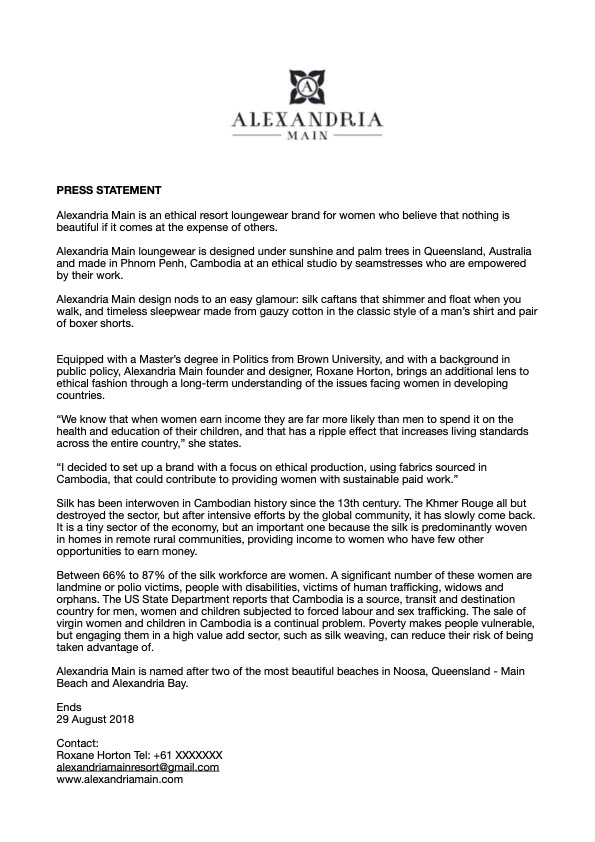
Your media statement is a one pager (no more than a page or you’ll lose the journalist’s interest) that gives a quick and snappy introduction to you and your brand. Write it in the third person but include a couple of grab quotes (your words) that a journalist could use in a story. It’s always useful to get someone else to do a proof read to make sure there are no typos. Make sure you include the following:
Logo at the top
Who you are
What you sell
Why it matters
(most importantly) What it is that makes you different from everyone else
Your contact details (include your brand’s web address/ Etsy address, social handles, phone number and email address)
Here’s an example of a media release I wrote when I first launched my brand (now closed):
PROFESSIONAL PHOTOS
You might be seeking to save some PR money by doing a media pitch yourself but unless you happen to be a professional photographer on the side you should never look to skimp on product photos by doing them yourself. Professionally taken photos are one of the best investments you can make. They will need to be high resolution but sent in medium or small res. It’s best to send just a couple of your pics in the first instance rather than linking to a whole dropbox folder. Always remember you are pitching to a busy person – your job is to make their job easy.
PRODUCT
I always think it is worth including product as part of your marketing budget and sending samples to media.
When I’ve worked in magazines we LOVED getting product. Not only did it make it easier for us to feel/see/smell the product than just seeing images or words, it was exciting to receive and open a package which gave us a good feeling about the brand even before we knew anything about them. Having product also meant we could photograph it in a way that best suited our magazine’s style.
The other advantage of sending product is that it gives you can excuse to have two points of contact, i.e. send an email with attached media statement and photos, then arrange to send product plus media statement and hand written note shortly after.
POST PITCH
You’ve pitched your brand. Now what? Sometimes a journalist will contact you to ask for more information/ more photographs. Sometimes they’ll just use your information in a story without giving you a heads up. Set up a Google alert with your name and your brand’s name so you get alerted to any media piece on you.
If it’s all silent you might want to send one more email, forwarding the original information, just to check whether there was any more information you could provide the journalist. If they don’t reply, let it rest. The timing might be wrong, they may have just written an article about hand-woven cotton or whatever it is you are selling, but they might have added to a content plan in a couple of months. Don’t harass. Just keep doing what you’re doing and when you release your next range, send through your information again.
The state of the fashion industry is always in constant flux, but especially so now. With supply chain issues, entire market segments in stagnation (when was the last time you wore a ball gown?) and fast-changing sales channels, it’s especially important to be aware of current issues and challenges. These three reports deep dive into the current state of the fashion industry and examine challenges and opportunities.
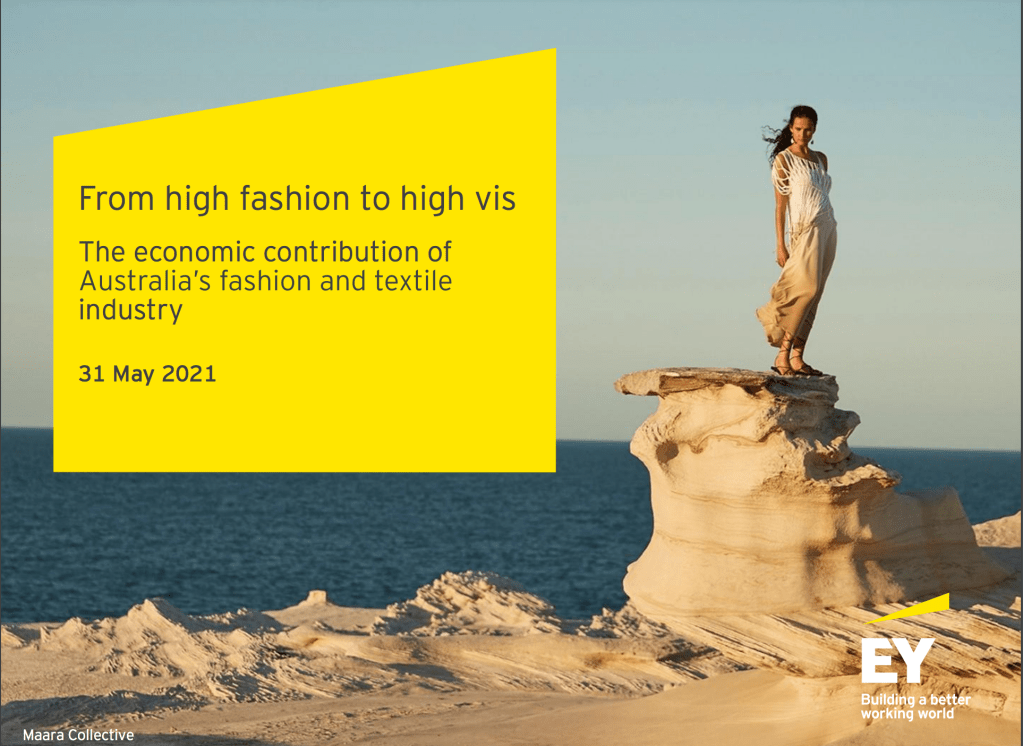
The Australian Fashion Council commissioned Ernst and Young’s landmark report into the state of the Australian fashion industry. The report finds Australia’s fashion and textile industry contributes more than $27.2 billion to the economy and employs more than 489,000 people, 77% of whom are women. Insights from key Australian fashion executives are useful for all Australian fashion businesses.
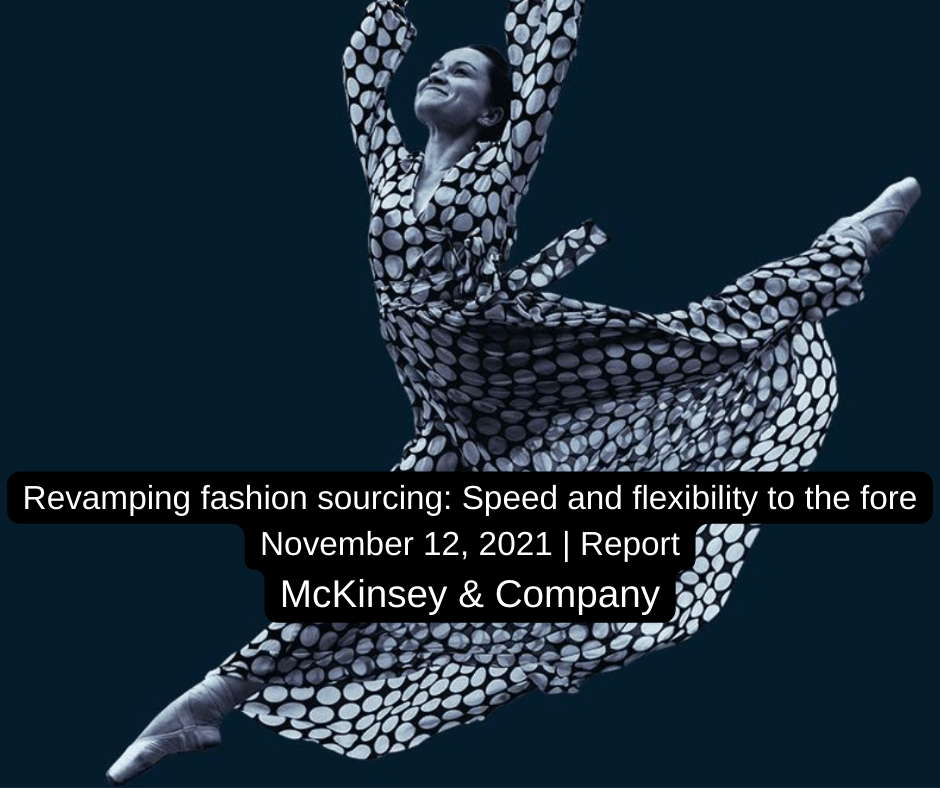
This McKinsey report focuses on the global fashion industry. It’s a long report at 144 pages, but worth making the time to scan the whole thing if you’re after a holistic analysis into where the industry is headed and the pain points – and solutions – that you might want to consider. There are relevant insights for small and large fashion brands.
Supply-chain disruptions have made fast, flexible sourcing a top priority for fashion companies. McKinsey’s survey of global sourcing executives reveals ambitious targets with much work still to do.
It’s Fashion Revolution Week. This is the week we remember the thousands of fast fashion workers who were killed and injured at Rana Plaza, Bangladesh. For those of us in the ethical fashion space, empathising with our garment worker and artisan friends in the developing world is something we are attuned to. In these COVID-19 times, where fears for our own health and economic security are uppermost in our minds, we can understand even more profoundly the challenges faced by those workers on a daily basis.
For resources, ways you can be part of the Fashion Revolution movement and some interesting reading, check out the following sources:
Fash Rev has masses of fantastic infographics and imagery that you can share across your own networks. Just remember to credit Fash Rev with @fash_rev (or whichever @fash_rev is in your country) and use the hastags #whomademyclothes #whatsinmyclothes #imadeyourclothes #fashionrevolution #fashrev #lovedclotheslast
This article in Peppermint magazine gives you seven ways to be involved with Fashion Revolution this week.
A piece on the Good On You website backgrounds the start of Fashion Revolution.
It’s a challenging and highly stressful week in the new, coronavirus world order. If you’re looking for something to distract you from from the constant uncertainty, these podcasts might help.
Dana Thomas’ first book, Deluxe: How Luxury Lost Its Luster, was groundbreaking in first drawing a link between our clothing and human rights abuses in the supply chain. In this podcast, Thomas discusses the findings of her follow up book, Fashionopolis: The Price of Fast Fashion and the Future of Clothes.
Vogue’s first Sustainability Editor, Clare Press’s Wardrobe Crisis is the podcast equivalent of the sustainable fashion bible. A global nomad, Clare is at every major fashion sustainability event around the world, which means her interviews are the most current and influential thinkers on the planet.
International Women’s Day is this Sunday, 8th March. It’s a day when women’s achievements are celebrated, and also a day in which areas of inequality are highlighted. Each year the UN give the day a special focus. The theme for 2020 is I am Generation Equality: Realizing Women’s Rights.
Unfortunately the fashion world is an area where equality still has a long way to being realised. Fash Rev have a fantastic campaign and loads of shareable assets to shed a light on the gender inequity in our fashion supply chains. More about the Fash Rev campaign is here. There’s a great supply of visuals for social media (just remember to credit Fash Rev and the photographer in your posts!)
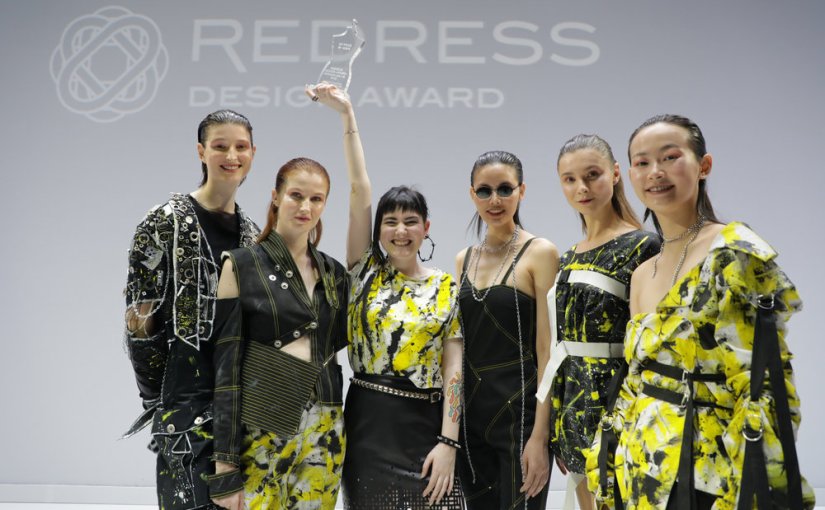
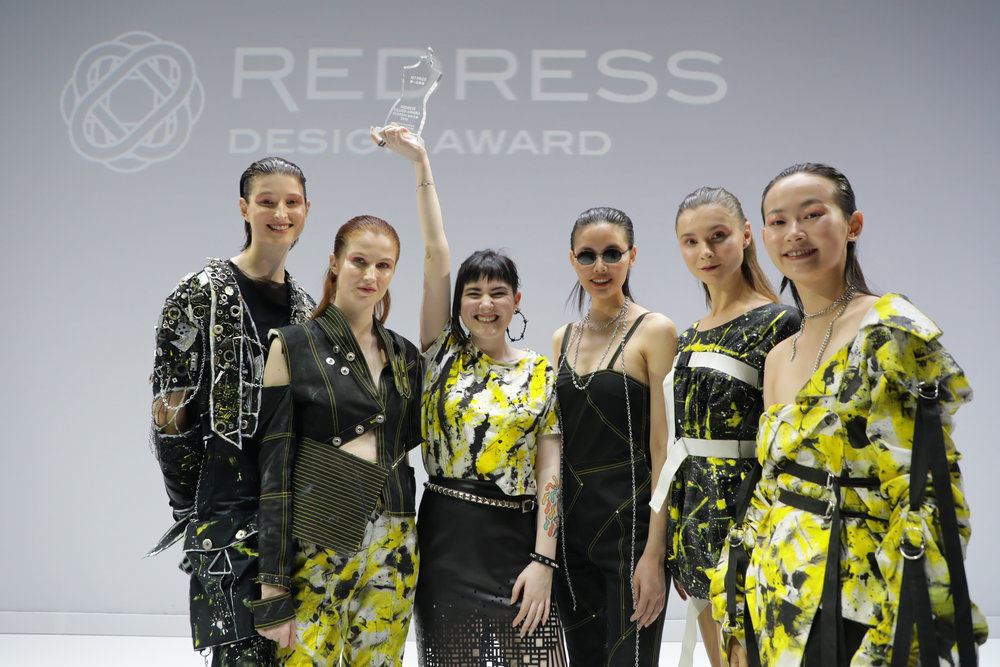
Entries are currently open to the world’s largest sustainable fashion design competition – The Redress Design Award. If you are a sustainable designer who has been in business for less than 4 years, this is for you! Get online and enter by 18th March 2020.
Organised by Hong Kong based, Redress, the competition ‘works to educate emerging fashion designers around the world about sustainable design theories and techniques in order to drive growth towards a circular fashion system. By putting sustainable design talent in the global spotlight, the competition creates a unique platform for passionate and talented fashion game-changers to transform the global fashion industry and rewards the best with career-changing prizes to maximise long-term impact.’
To get a better understanding of how it all works, watch Frontline Fashion, which documents the 2019 finalists as they all prep to present their collections. Must Watch!
Those generous people at the world-leading London College of Fashion’s Centre for Sustainable Fashion, along with Kering Group (owner of Gucci, Balenciaga, YSL and other luminary luxury brands), have produced a fab FREE (yes, you read that right) online course available through Future Learn. I’ve done a few of these online courses before and I can’t praise them enough. The content is valuable and super interesting, and the online chat facility means you can network while sitting in your bedroom in your pjs. Fashion and Sustainability: Understanding Luxury Fashion in a Changing Worldis a 6-week course exploring key sustainability issues, agendas and contexts associated with luxury fashion. It looks at sourcing and design all in the framework of sustainability. The lecturers are the totally inspiring Dilys Williams (check out her interview with Vogue’s Sustainability editor, Clare Press on Clare’s podcast, Wardrobe Crisis if you haven’t heard of her), Nina Stevenson and Gabrielle Miller, all from Centre for Sustainable Fashion at London College of Fashion. The course starts Feb 24. You sign up and follow along each day as they upload new content. You could theoretically cram the whole 6 weeks into the last week if you had to, but my hot tip is to do it as live-time as possible in order to get the most out of the group chats and lecturer feed back.
Fashion leaders ASOS, H&M, Nike, Kering Group (owners of luxury brands Gucci, Bottega Veneta, Saint Laurent amongst others) were part of a group of the biggest fashion corporates who launched a broad sustainability agenda called CEO Agenda 2020, during the recent World Economic Forum in Davos. It’s a little vague on specifics, and written in management consultant language, but it sets out the broad areas that sustainable fashion leaders will need to focus on now and in the future. Click here for the full text.



 Connecting the Asia Pacific ethical designer community